OpenAI Tangents
OpenAI Tangents
ROLE
Product Designer
TIMELINE
January 20 - March 10, 2026
TEAM
Solo!
SKILLS
Product Design & Motion Design,
UX/UI Design, Icon Design
ROLE
Product Designer
TIMELINE
January 20 - March 10, 2026
TEAM
Solo!
SKILLS
Product Design & Motion Design,
UX/UI Design, Icon Design
ROLE
Product Designer
TIMELINE
January 20 - March 10, 2026
TEAM
Solo!
SKILLS
Product Design & Motion Design,
UX/UI Design, Icon Design
OVERVIEW
When does AI stop being a tool and start shaping how we think?
As AI becomes integrated into daily thinking, there’s a risk it becomes a hindrance rather than a catalyst. OpenAI Tangents reimagines ChatGPT as a cognitive mirror helping users explore their thinking patterns, not just complete tasks faster.
When does AI stop being a tool and start shaping how we think?
As AI becomes integrated into daily thinking, there’s a risk it becomes a hindrance rather than a catalyst. OpenAI Tangents reimagines ChatGPT as a cognitive mirror helping users explore their thinking patterns, not just complete tasks faster.
When does AI stop being a tool and start shaping how we think?
As AI becomes integrated into daily thinking, there’s a risk it becomes a hindrance rather than a catalyst. OpenAI Tangents reimagines ChatGPT as a cognitive mirror helping users explore their thinking patterns, not just complete tasks faster.
PROBLEM
ChatGPT makes it easy to offload thinking, but hard to understand it.
By forcing complex, non-linear reasoning into linear chat threads, users lose visibility into how ideas connect, evolve, and repeat, turning thinking into disposable output rather than cumulative understanding.
ChatGPT makes it easy to offload thinking, but hard to understand it.
By forcing complex, non-linear reasoning into linear chat threads, users lose visibility into how ideas connect, evolve, and repeat, turning thinking into disposable output rather than cumulative understanding.
ChatGPT makes it easy to offload thinking, but hard to understand it.
By forcing complex, non-linear reasoning into linear chat threads, users lose visibility into how ideas connect, evolve, and repeat, turning thinking into disposable output rather than cumulative understanding.
MOMENT
Reflection as the missing layer in conversational AI.
ChatGPT already captures rich signals about how users think. Your Year with ChatGPT is a personal year-in-review that reflects how you used ChatGPT over the past year. But these insights arrived once a year, despite ChatGPT capturing signals of curiosity, reasoning, and interest every day.
Reflection as the missing layer in conversational AI.
ChatGPT already captures rich signals about how users think. Your Year with ChatGPT is a personal year-in-review that reflects how you used ChatGPT over the past year. But these insights arrived once a year, despite ChatGPT capturing signals of curiosity, reasoning, and interest every day.
Reflection as the missing layer in conversational AI.
ChatGPT already captures rich signals about how users think. Your Year with ChatGPT is a personal year-in-review that reflects how you used ChatGPT over the past year. But these insights arrived once a year, despite ChatGPT capturing signals of curiosity, reasoning, and interest every day.
The spark is realizing that the value isn’t just in storing this data, it’s in surfacing it continuously, helping users visualize their thinking, explore tangents, and discover connections in real time.
Patterns create meaning
Reflection transforms history into insight.
Reflection should be continuous
Annual summaries delay awareness that could happen instantly.
Thinking amplification
AI becomes a partner in sensemaking, not just output.
Patterns create meaning
Reflection transforms history into insight.
Reflection should be continuous
Annual summaries delay awareness that could happen instantly.
Thinking amplification
AI becomes a partner in sensemaking, not just output.
SOLUTION
Design AI systems that make human thinking visible, explorable, and cumulative
FLOWS
Making Thinking Visible
Tangent Branching
Fork any conversation to explore related ideas without losing your place.
Connection Mapping
Visualize how your conversations relate through an interactive grid view.
Intelligent Suggestions
ChatGPT actively surfaces relevant past conversations and suggests meaningful connections.
Thinking Patterns Dashboard
Periodic insights that reveal how your thinking evolves over time.
SECONDARY RESEARCH
The Hidden Cost of Helpful AI
To understand how conversational AI shapes thinking, I studied real-world ChatGPT usage over time and reviewed existing online research on AI-supported cognition, looking at how users explored ideas, followed tangents, and revisited similar questions.
The Hidden Cost of Helpful AI
To understand how conversational AI shapes thinking, I studied real-world ChatGPT usage over time and reviewed existing online research on AI-supported cognition, looking at how users explored ideas, followed tangents, and revisited similar questions.
The Hidden Cost of Helpful AI
To understand how conversational AI shapes thinking, I studied real-world ChatGPT usage over time and reviewed existing online research on AI-supported cognition, looking at how users explored ideas, followed tangents, and revisited similar questions.
Across these interactions, three patterns emerged, along with a key insight.
Thinking is non-linear, chat is not
Users explored ideas through associations and tangents, but the interface forced linear progression.
AI encourages cognitive offloading
Fast answers reduce reflection and sensemaking.
Patterns exist, but remain invisible
Users repeatedly explore similar topics without awareness.
Thinking is non-linear, chat is not
Users explored ideas through associations and tangents, but the interface forced linear progression.
AI encourages cognitive offloading
Fast answers reduce reflection and sensemaking.
Patterns exist, but remain invisible
Users repeatedly explore similar topics without awareness.
KEY INSIGHT
Reflection increases engagement: When shown their own usage patterns, users became more self-aware.
AI needs to externalize thinking, not just accelerate it, by making ideas visible, connected, and reflective, so users stay actively engaged in their own reasoning. This shift from linear chat to dynamic, pattern-revealing interfaces can turn passive offloading into active cognition, allowing deeper self-awareness and exploration. Two behavior patterns, observed consistently across usage, show exactly where this breakdown occurs.
BEHAVIORAL ARCHETYPES
Shifting Modes of Thought
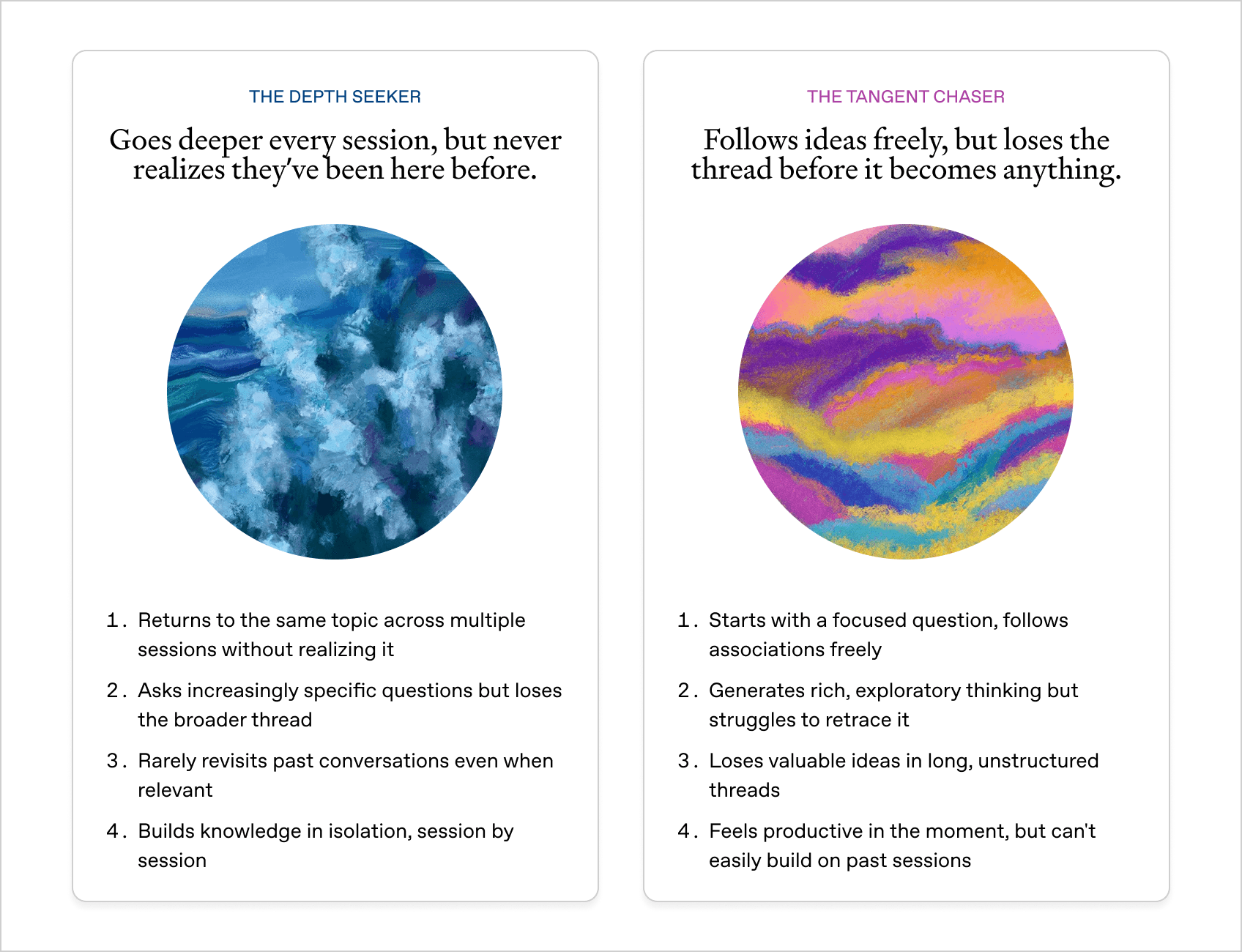
Two recurring behavior patterns emerged from studying how users engage with ChatGPT over time. Rather than distinct user types, these archetypes describe modes of thinking that most users shift between, often within a single session. Both patterns point to the same underlying gap: rich thinking happens, but nothing accumulates.
Shifting Modes of Thought
Two recurring behavior patterns emerged from studying how users engage with ChatGPT over time. Rather than distinct user types, these archetypes describe modes of thinking that most users shift between, often within a single session. Both patterns point to the same underlying gap: rich thinking happens, but nothing accumulates.
Shifting Modes of Thought
Two recurring behavior patterns emerged from studying how users engage with ChatGPT over time. Rather than distinct user types, these archetypes describe modes of thinking that most users shift between, often within a single session. Both patterns point to the same underlying gap: rich thinking happens, but nothing accumulates.
BEFORE / AFTER MENTAL MODEL
Conversations That Compound
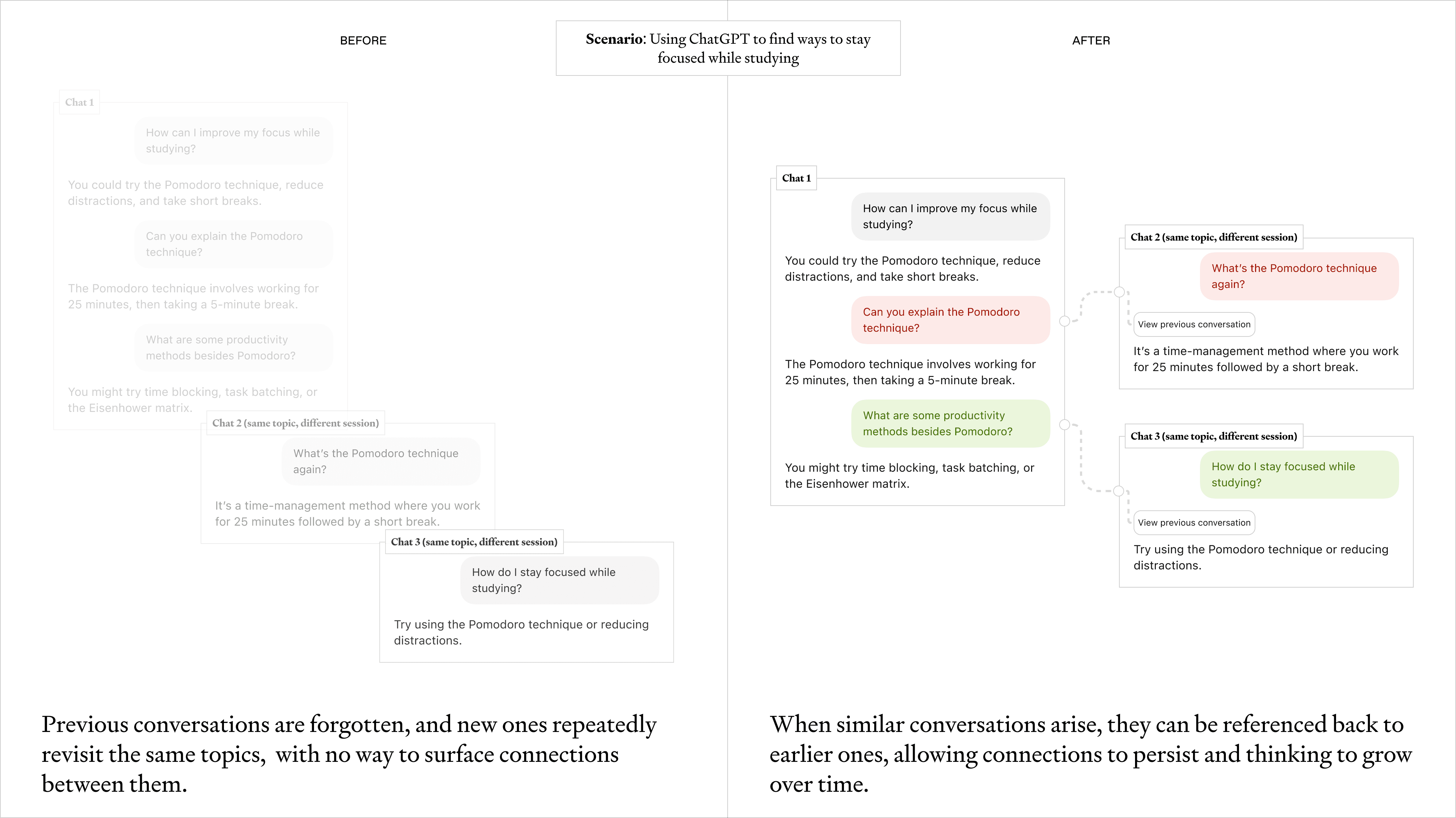
The core shift Tangents proposes is not a new feature, it is a new mental model for what a conversation can be. Currently, users experience ChatGPT as a series of isolated threads: useful in the moment, invisible over time. Tangents reframes each conversation as a node in a growing map of thought
Conversations That Compound
The core shift Tangents proposes is not a new feature, it is a new mental model for what a conversation can be. Currently, users experience ChatGPT as a series of isolated threads: useful in the moment, invisible over time. Tangents reframes each conversation as a node in a growing map of thought
Conversations That Compound
The core shift Tangents proposes is not a new feature, it is a new mental model for what a conversation can be. Currently, users experience ChatGPT as a series of isolated threads: useful in the moment, invisible over time. Tangents reframes each conversation as a node in a growing map of thought
WHAT I TRIED AND WHY I MOVED ON
Approaches Explored
Before the final direction took shape, I explored three approaches to making thinking visible. Each solved part of the problem but fell short in a critical way. The goal was to find a system that revealed patterns without adding effort.
Approaches Explored
Before the final direction took shape, I explored three approaches to making thinking visible. Each solved part of the problem but fell short in a critical way. The goal was to find a system that revealed patterns without adding effort.
Approaches Explored
Before the final direction took shape, I explored three approaches to making thinking visible. Each solved part of the problem but fell short in a critical way. The goal was to find a system that revealed patterns without adding effort.
Direction 1: The Timeline View
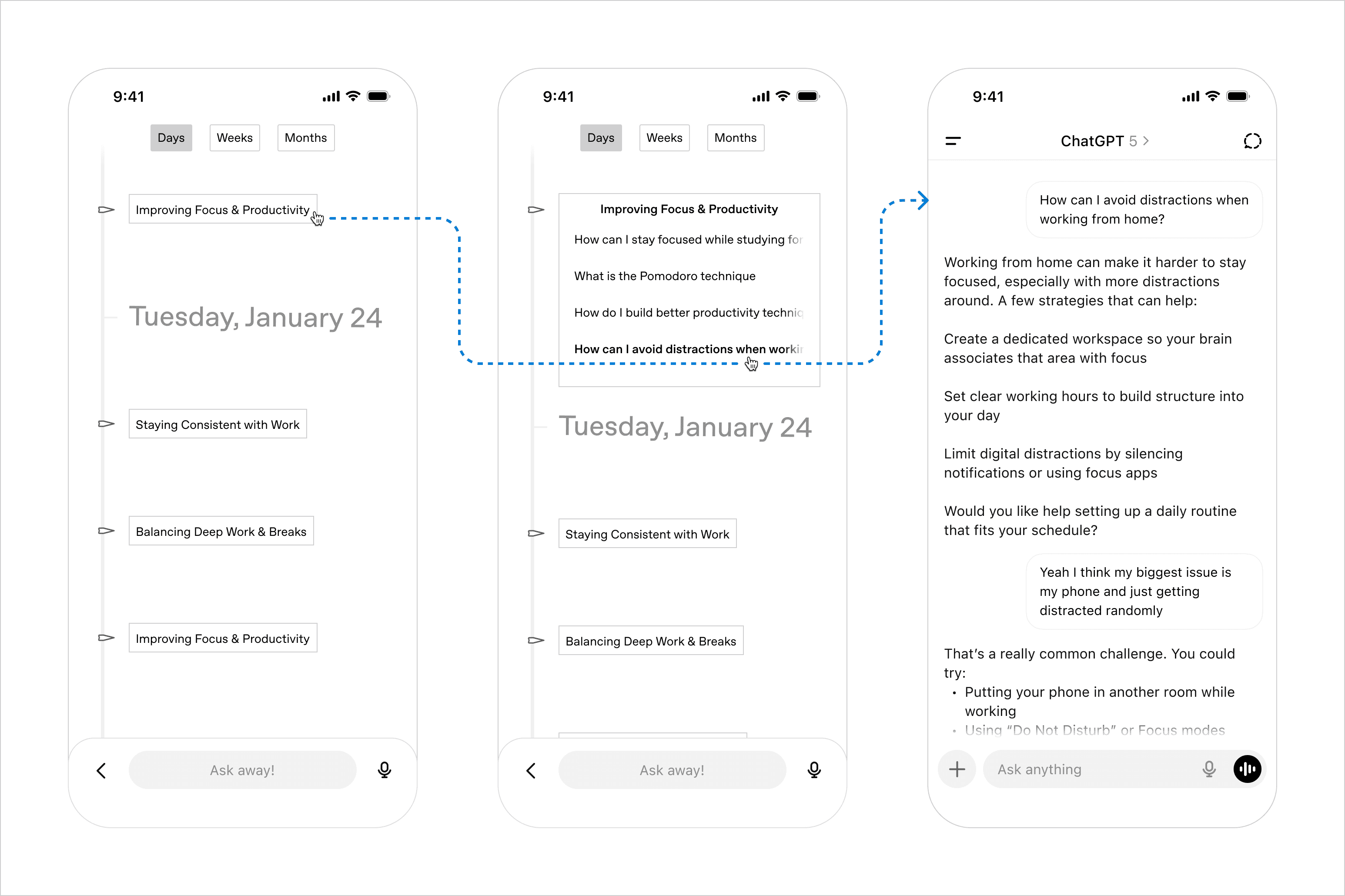
I first explored organizing thinking chronologically. It made history easy to scan but reduced ideas to sequence, showing when, not how they connected or evolved. It functioned better as a reflective layer, later embedded in the Thinking Patterns Dashboard rather than the core system.
Direction 1: The Timeline View
I first explored organizing thinking chronologically. It made history easy to scan but reduced ideas to sequence, showing when, not how they connected or evolved. It functioned better as a reflective layer, later embedded in the Thinking Patterns Dashboard rather than the core system.
Direction 1: The Timeline View
I first explored organizing thinking chronologically. It made history easy to scan but reduced ideas to sequence, showing when, not how they connected or evolved. It functioned better as a reflective layer, later embedded in the Thinking Patterns Dashboard rather than the core system.
Direction 2: The Tagging and Clusters System
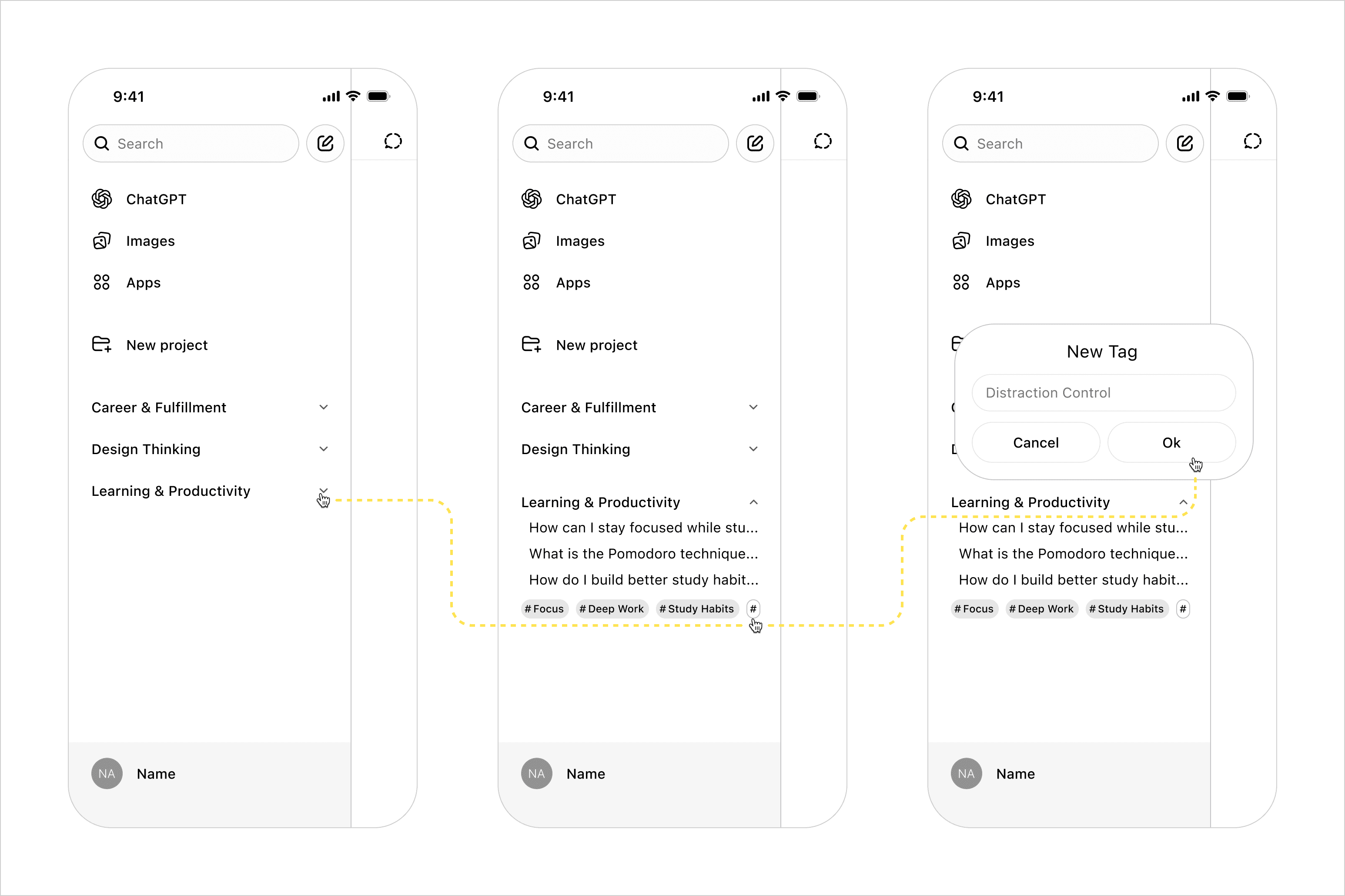
Categorization surfaced patterns but front-loaded effort. Users had to organize their thinking before they could see it, which worked against the exploratory nature of how ChatGPT is actually used. Intelligent Suggestions needed to work passively, not depend on users doing organizational work upfront.
Direction 2: The Tagging and Clusters System
Categorization surfaced patterns but front-loaded effort. Users had to organize their thinking before they could see it, which worked against the exploratory nature of how ChatGPT is actually used. Intelligent Suggestions needed to work passively, not depend on users doing organizational work upfront.
Direction 2: The Tagging and Clusters System
Categorization surfaced patterns but front-loaded effort. Users had to organize their thinking before they could see it, which worked against the exploratory nature of how ChatGPT is actually used. Intelligent Suggestions needed to work passively, not depend on users doing organizational work upfront.
Direction 3: The Node Canvas
The node canvas matched how thinking actually works. The system could surface connections passively while users explored freely. This became the foundation for Connection Mapping, and the spatial logic carried into how Tangent Branching and Intelligent Suggestions are anchored, always in context, never pulling users away from their current thought.
Direction 3: The Node Canvas
The node canvas matched how thinking actually works. The system could surface connections passively while users explored freely. This became the foundation for Connection Mapping, and the spatial logic carried into how Tangent Branching and Intelligent Suggestions are anchored, always in context, never pulling users away from their current thought.
Direction 3: The Node Canvas
The node canvas matched how thinking actually works. The system could surface connections passively while users explored freely. This became the foundation for Connection Mapping, and the spatial logic carried into how Tangent Branching and Intelligent Suggestions are anchored, always in context, never pulling users away from their current thought.
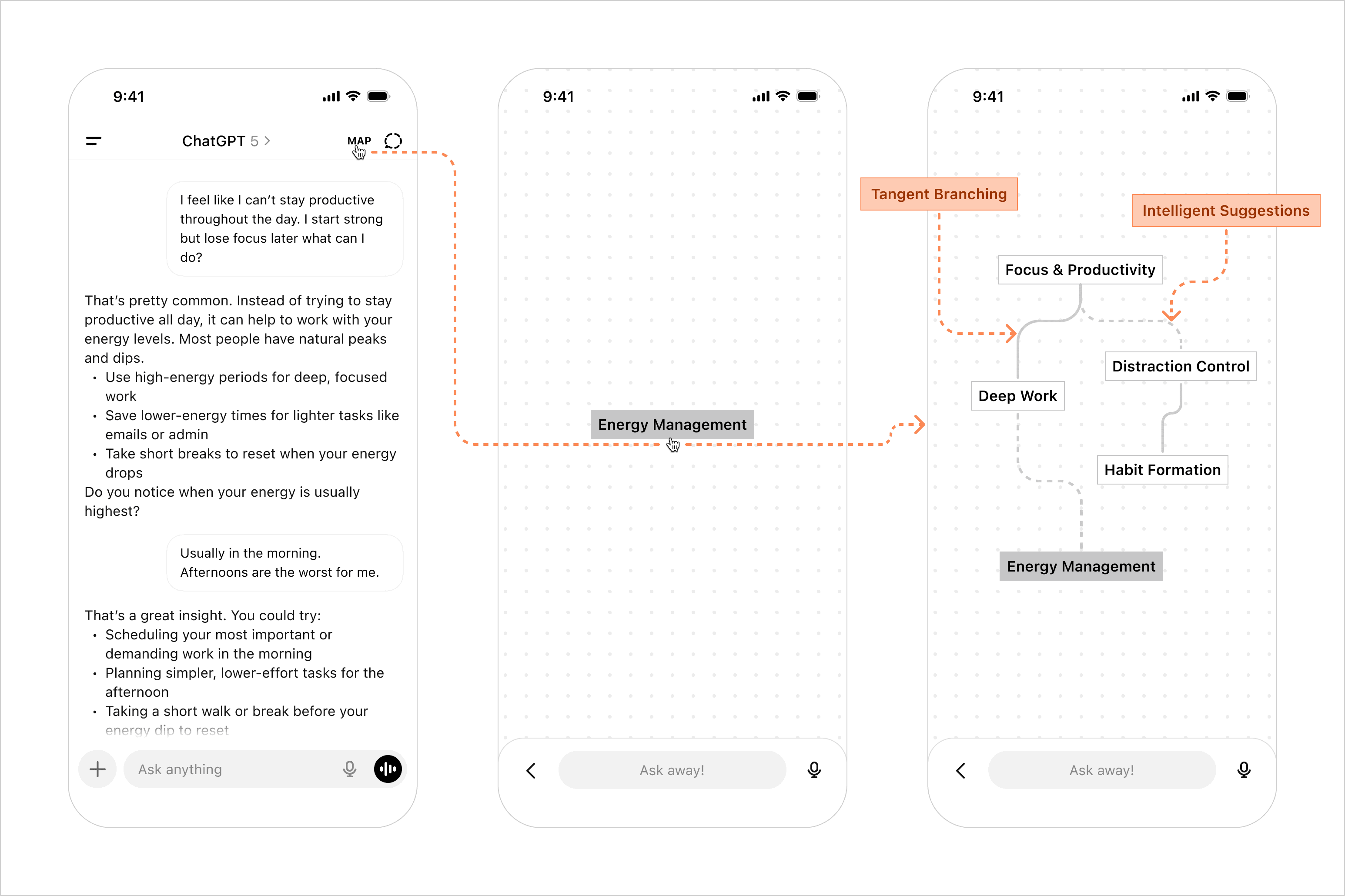
Each direction clarified the same constraint: structure imposed on thinking creates resistance. The right solution needed to feel like it was revealing something already there. That became the filter for every decision that followed.
PRINCIPLES AND STRUCTURE
Learning from Node-Based Canvases and Patch Flows
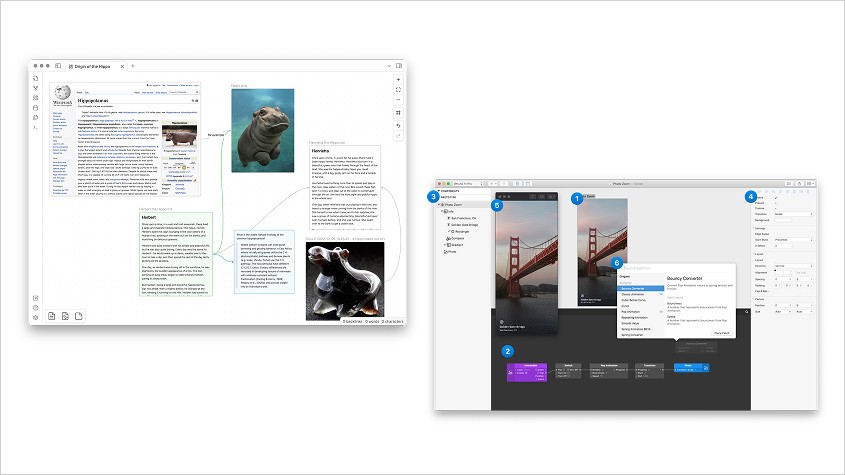
My thinking drew from the node-based canvas of Obsidian Canvas and the structured, directional flows of the Origami Studio 3 patch editor. I focused on enabling visual freedom while still maintaining a clear beginning and end to a thought.
Learning from Node-Based Canvases and Patch Flows
My thinking drew from the node-based canvas of Obsidian Canvas and the structured, directional flows of the Origami Studio 3 patch editor. I focused on enabling visual freedom while still maintaining a clear beginning and end to a thought.
Learning from Node-Based Canvases and Patch Flows
My thinking drew from the node-based canvas of Obsidian Canvas and the structured, directional flows of the Origami Studio 3 patch editor. I focused on enabling visual freedom while still maintaining a clear beginning and end to a thought.
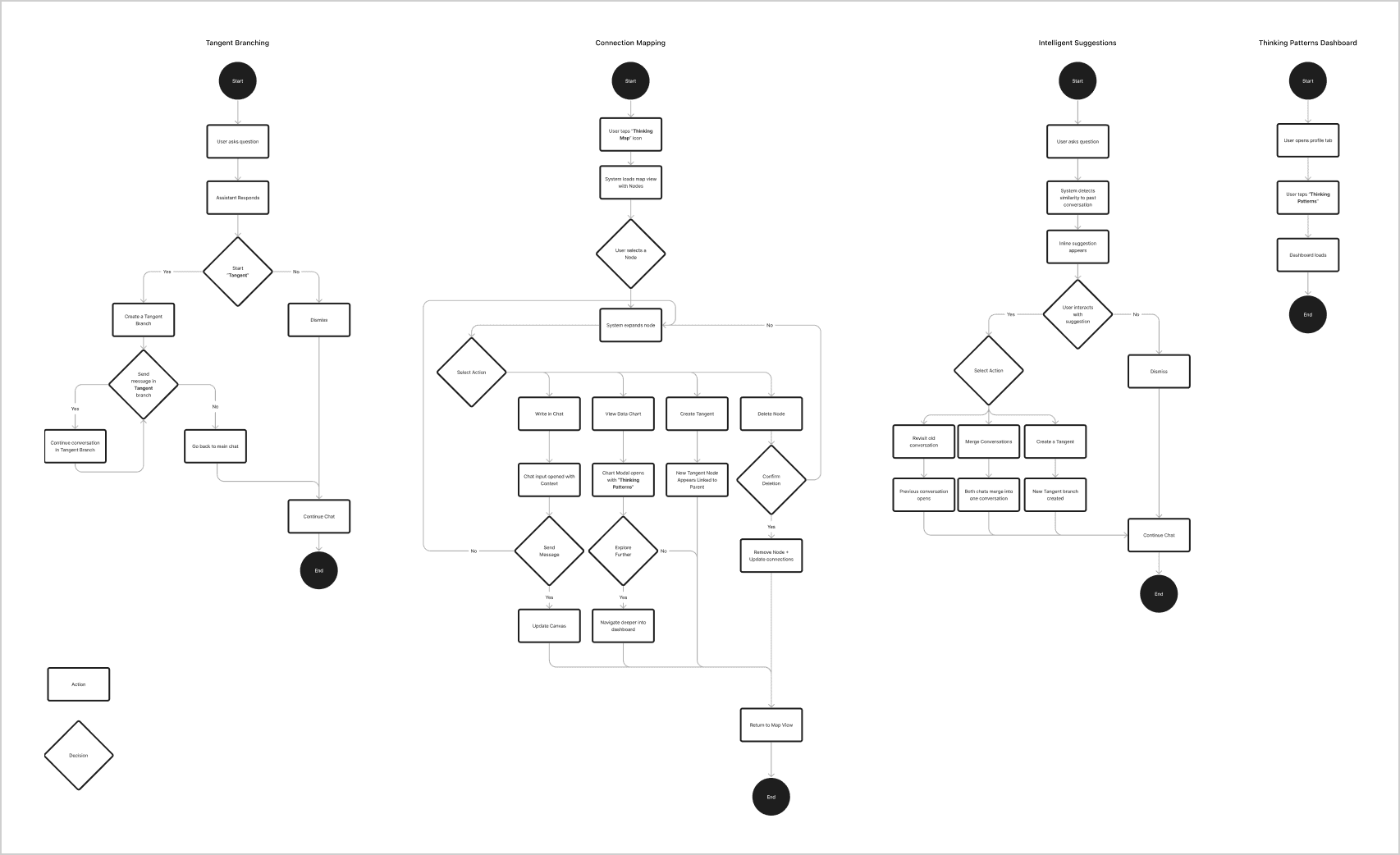
To carry this thinking forward, I mapped the core interactions as flows, capturing how users can explore ideas freely while still moving through a defined start and progression.
DESIGN SYSTEM & COMPONENTS
Designed to Feel Native
Every new component was designed to extend ChatGPT's existing visual language, not replace it. The goal was for new elements to feel native to the interface while remaining distinct enough to signal new behavior.
Designed to Feel Native
Every new component was designed to extend ChatGPT's existing visual language, not replace it. The goal was for new elements to feel native to the interface while remaining distinct enough to signal new behavior.
Designed to Feel Native
Every new component was designed to extend ChatGPT's existing visual language, not replace it. The goal was for new elements to feel native to the interface while remaining distinct enough to signal new behavior.
Colour
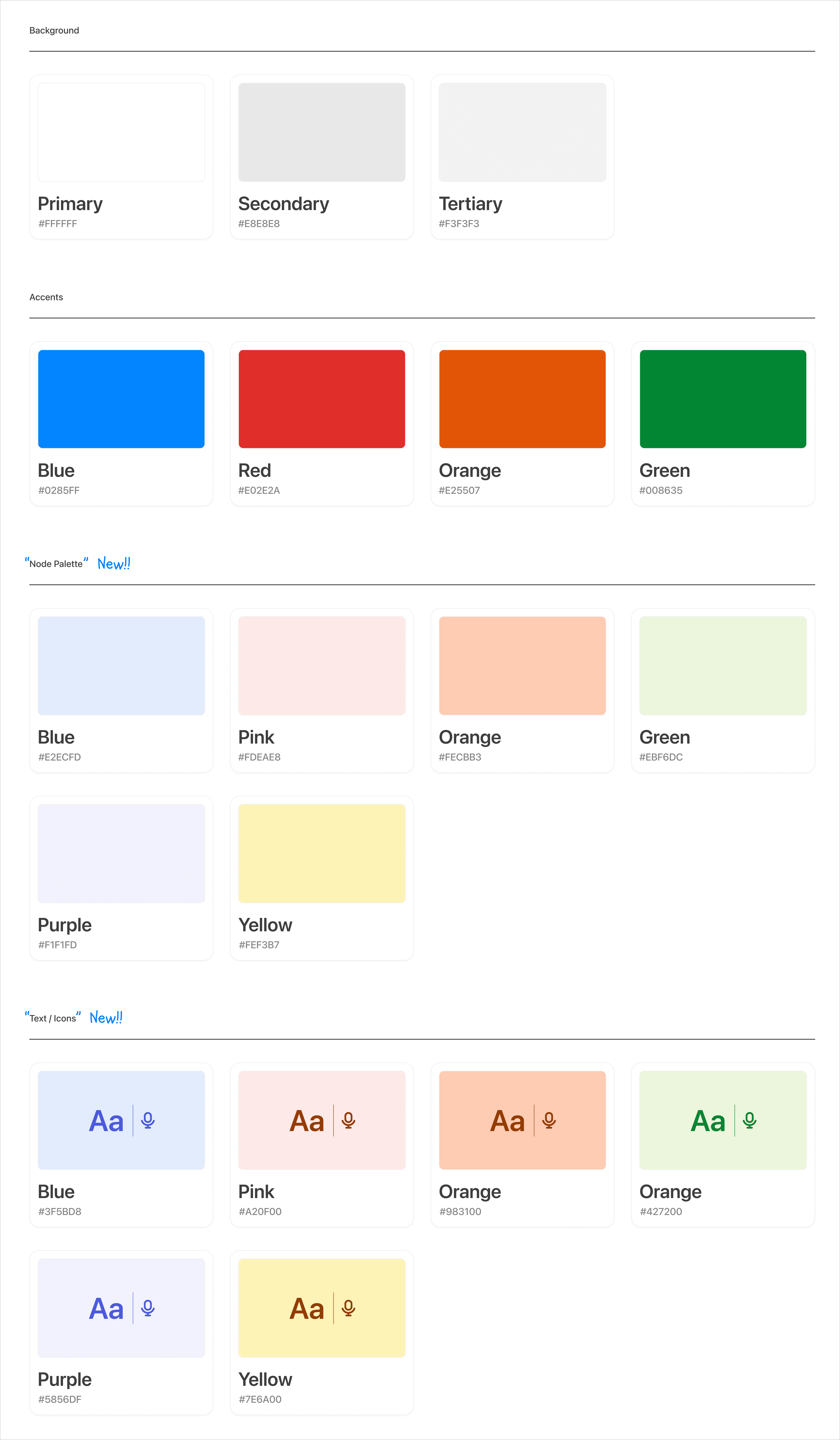
Six new values were introduced exclusively for Tangent nodes and their associated text, everything else inherits from ChatGPT's existing design language
Colour
Six new values were introduced exclusively for Tangent nodes and their associated text, everything else inherits from ChatGPT's existing design language
Colour
Six new values were introduced exclusively for Tangent nodes and their associated text, everything else inherits from ChatGPT's existing design language
Typography
SF Pro is used throughout, no new typeface introduced. As a native iOS font, it keeps the experience feeling familiar and reduces cognitive friction for existing users. All typographic hierarchy and weight is inherited directly from ChatGPT's existing design language.
Typography
SF Pro is used throughout, no new typeface introduced. As a native iOS font, it keeps the experience feeling familiar and reduces cognitive friction for existing users. All typographic hierarchy and weight is inherited directly from ChatGPT's existing design language.
Typography
SF Pro is used throughout, no new typeface introduced. As a native iOS font, it keeps the experience feeling familiar and reduces cognitive friction for existing users. All typographic hierarchy and weight is inherited directly from ChatGPT's existing design language.
Naming
Naming was treated as a design decision. Tangent was chosen over "branch" or "thread" because it better describes the behavior, an idea that stems naturally from another without replacing it. Suggestion was chosen over "recommendation" to signal that the system is offering, not directing. Every term was chosen to keep users feeling in control of their own thinking.
Naming
Naming was treated as a design decision. Tangent was chosen over "branch" or "thread" because it better describes the behavior, an idea that stems naturally from another without replacing it. Suggestion was chosen over "recommendation" to signal that the system is offering, not directing. Every term was chosen to keep users feeling in control of their own thinking.
Naming
Naming was treated as a design decision. Tangent was chosen over "branch" or "thread" because it better describes the behavior, an idea that stems naturally from another without replacing it. Suggestion was chosen over "recommendation" to signal that the system is offering, not directing. Every term was chosen to keep users feeling in control of their own thinking.
Iconography
All icons follow ChatGPT's existing icon style. Three new icons were introduced for Tangent-specific interactions, designed to match this established visual language so new functionality feels native rather than added on.
Iconography
All icons follow ChatGPT's existing icon style. Three new icons were introduced for Tangent-specific interactions, designed to match this established visual language so new functionality feels native rather than added on.
Iconography
All icons follow ChatGPT's existing icon style. Three new icons were introduced for Tangent-specific interactions, designed to match this established visual language so new functionality feels native rather than added on.
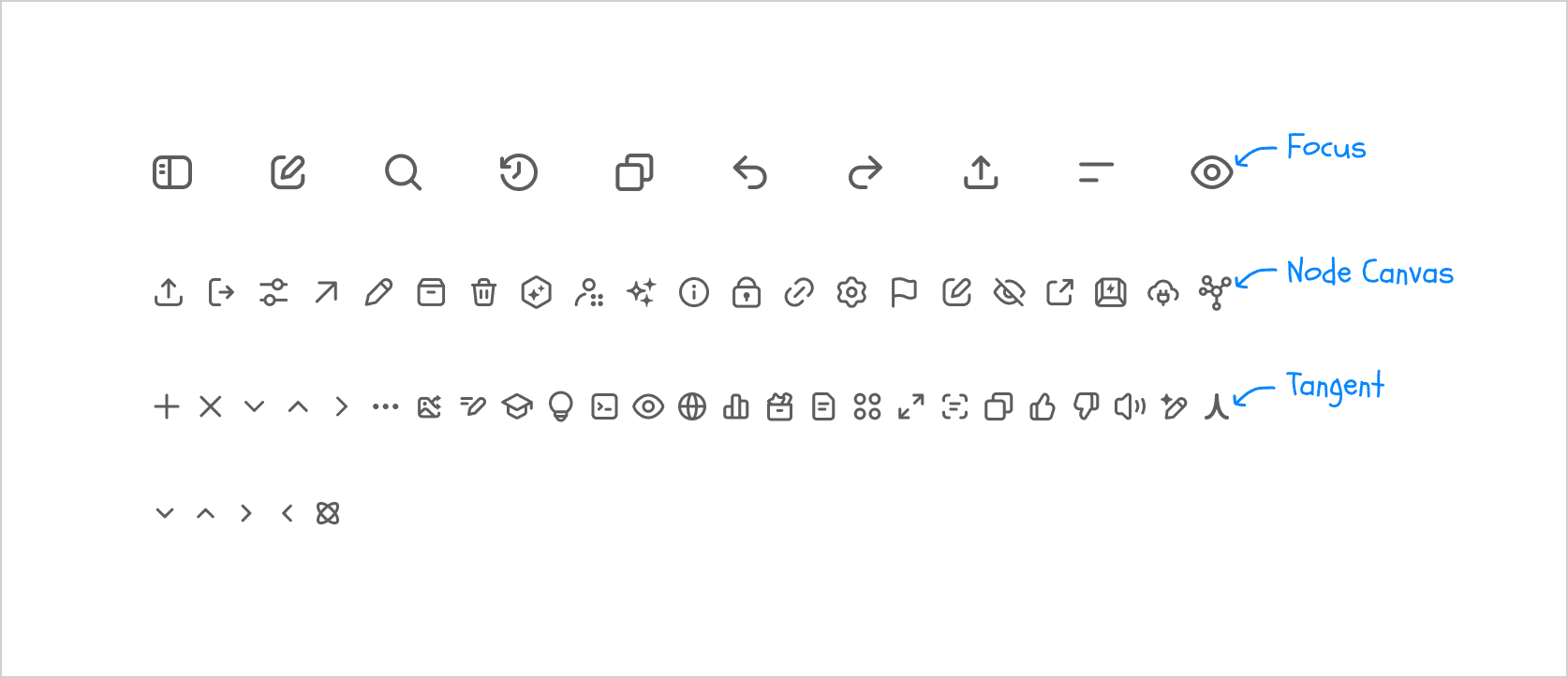
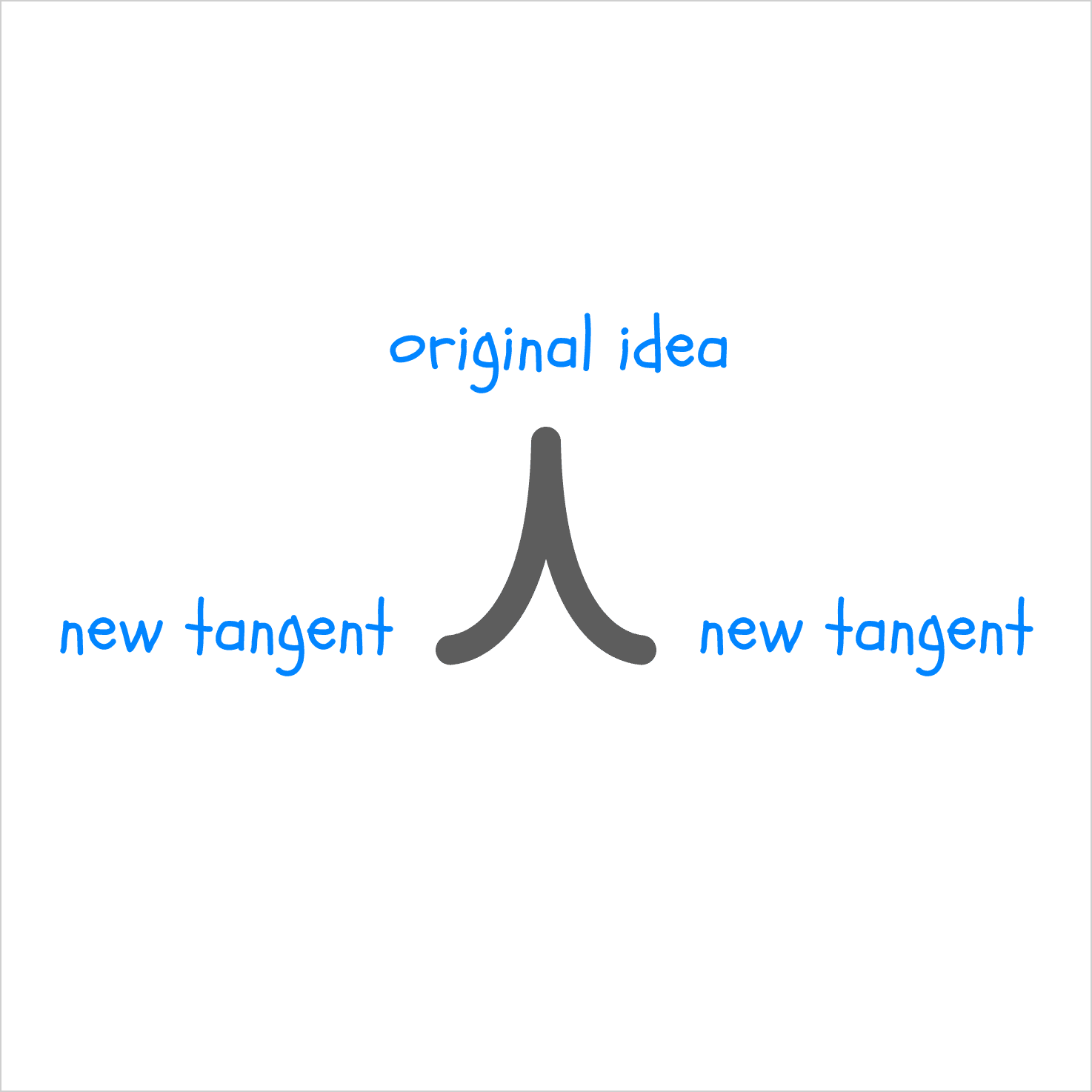
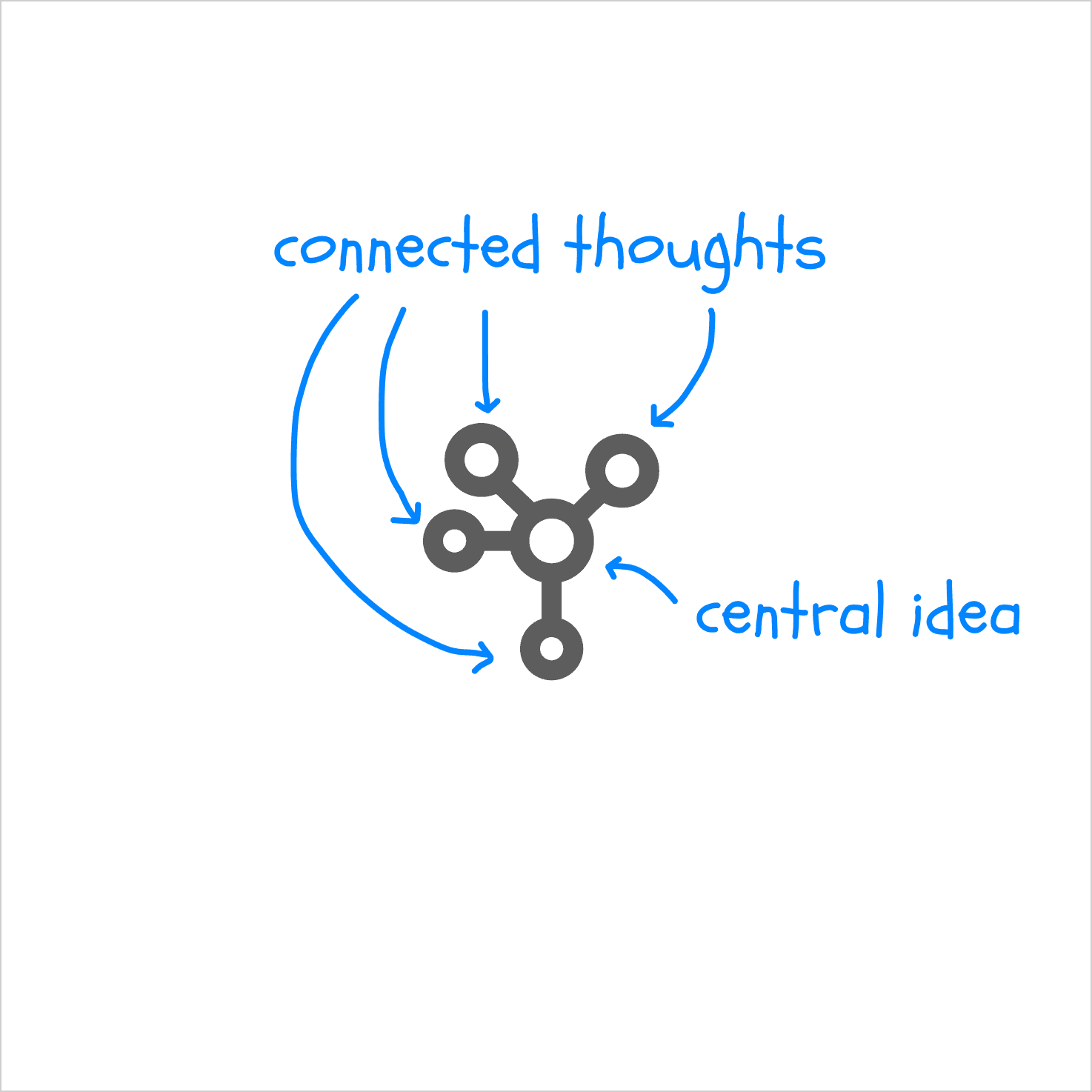
Each icon was designed to communicate behavior, not just label a function. The Tangent icon shows a new idea branching from an existing one, while the Node Canvas icon uses a hub-and-spoke structure to represent a central idea connected outward. Both make the interaction legible at a glance.
DESIGN DECISIONS
Branching Conversations
Branching is initiated directly from a message rather than a separate tool, keeping the interaction lightweight and integrated into the natural flow of chat. This reduces friction and prevents users from feeling overwhelmed by the need to manage structure.
Branching Conversations
Branching is initiated directly from a message rather than a separate tool, keeping the interaction lightweight and integrated into the natural flow of chat. This reduces friction and prevents users from feeling overwhelmed by the need to manage structure.
Branching Conversations
Branching is initiated directly from a message rather than a separate tool, keeping the interaction lightweight and integrated into the natural flow of chat. This reduces friction and prevents users from feeling overwhelmed by the need to manage structure.
Each branch preserves the original context and provides clear navigation between related paths, allowing users to explore ideas at multiple depths without losing their place.
Intelligent Suggestions
Suggestions are intentionally limited and high-confidence, designed to surface meaningful connections, reflection, and idea expansion rather than simply prompting the next response. They appear as natural pauses within the conversation and are framed as optional prompts, not directives, so users remain in control of their thinking flow
Intelligent Suggestions
Suggestions are intentionally limited and high-confidence, designed to surface meaningful connections, reflection, and idea expansion rather than simply prompting the next response. They appear as natural pauses within the conversation and are framed as optional prompts, not directives, so users remain in control of their thinking flow
Intelligent Suggestions
Suggestions are intentionally limited and high-confidence, designed to surface meaningful connections, reflection, and idea expansion rather than simply prompting the next response. They appear as natural pauses within the conversation and are framed as optional prompts, not directives, so users remain in control of their thinking flow
Reflection Layer
The Thinking Patterns Dashboard brings everything together in a dedicated space within the sidebar, giving users quick access to their cognitive activity over time. It is designed to support both short-term reflection on recent conversations and long-term awareness of evolving interests, habits, and connections in their thinking.
Reflection Layer
The Thinking Patterns Dashboard brings everything together in a dedicated space within the sidebar, giving users quick access to their cognitive activity over time. It is designed to support both short-term reflection on recent conversations and long-term awareness of evolving interests, habits, and connections in their thinking.
Reflection Layer
The Thinking Patterns Dashboard brings everything together in a dedicated space within the sidebar, giving users quick access to their cognitive activity over time. It is designed to support both short-term reflection on recent conversations and long-term awareness of evolving interests, habits, and connections in their thinking.
Connection Mapping
A node-based map view was chosen over a traditional list to better support visual thinking and pattern recognition. Instead of navigating users away from the map, nodes expand inline to reveal more detail. This keeps users oriented within their thinking space, allowing them to explore connections without losing context or disrupting their flow.
Connection Mapping
A node-based map view was chosen over a traditional list to better support visual thinking and pattern recognition. Instead of navigating users away from the map, nodes expand inline to reveal more detail. This keeps users oriented within their thinking space, allowing them to explore connections without losing context or disrupting their flow.
Connection Mapping
A node-based map view was chosen over a traditional list to better support visual thinking and pattern recognition. Instead of navigating users away from the map, nodes expand inline to reveal more detail. This keeps users oriented within their thinking space, allowing them to explore connections without losing context or disrupting their flow.
Dotted links between nodes are generated by the system to reduce user effort and surface relationships that may otherwise go unnoticed. By making these hidden patterns visible, the interface supports reflection and helps users recognize how their ideas connect over time.
REFLECTION
What I learned
Designing for thinking, not just tasks
This project pushed me to move beyond designing for task completion and instead consider how interfaces shape curiosity, reflection, and sensemaking. It reframed my definition of success in AI, from faster answers to more intentional thinking.
Making the invisible visible
Working with thinking patterns meant designing for something users can’t normally see. I learned to translate behaviors like revisiting ideas, following tangents, and forming connections into visuals that feel clear, lightweight, and immediately understandable.
Designing for thinking, not just tasks
This project pushed me to move beyond designing for task completion and instead consider how interfaces shape curiosity, reflection, and sensemaking. It reframed my definition of success in AI, from faster answers to more intentional thinking.
Making the invisible visible
Working with thinking patterns meant designing for something users can’t normally see. I learned to translate behaviors like revisiting ideas, following tangents, and forming connections into visuals that feel clear, lightweight, and immediately understandable.
Balancing structure and freedom
Users need the freedom to explore ideas, but also a sense of orientation. Designing that balance, between open exploration and clear progression, became central to every feature decision.
Designing with the system, not just for the user
This work reinforced that AI experiences are co-created. The system has a role in surfacing patterns, suggesting connections, and prompting reflection. I learned to design these system behaviors to feel supportive, timely, and never intrusive.
Balancing structure and freedom
Users need the freedom to explore ideas, but also a sense of orientation. Designing that balance, between open exploration and clear progression, became central to every feature decision.
Designing with the system, not just for the user
This work reinforced that AI experiences are co-created. The system has a role in surfacing patterns, suggesting connections, and prompting reflection. I learned to design these system behaviors to feel supportive, timely, and never intrusive.